Showing posts with label anatomy. Show all posts

Thursday, January 12, 2017

Wolf Study

Used an anatomy study as an excuse to try out stylized fur. No symmetry used for added difficulty. Here are a bunch of random renders ~


Some comps of zbrush BPR renders


Sunday, May 1, 2016

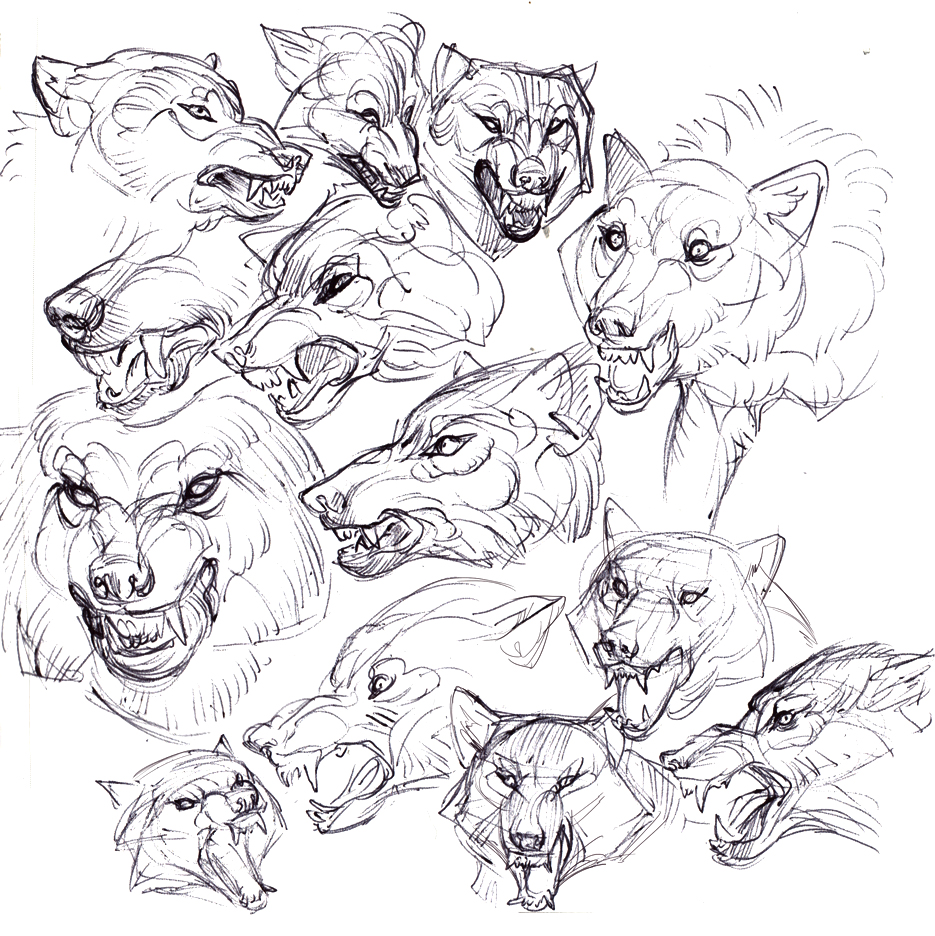
Snarl Barrage

So... much... scanning.
As usual, lots of aimless doodles and animal practice; primarily horses and snarly dog lips.


Thursday, September 24, 2015

Cougar Mountain Zoo

Sketches from a zoo trip. 
Spoilers: I didn't draw any of the cougars.
There are however shaved alpacas, hyacinth macaws, tigers, wallabies, emus, and crowned cranes.


Friday, February 15, 2013

Sculpting

Been very busy lately with school and contract work. I've started plenty of personal paintings but haven't had the time to finish any of them up yet. Those that I have finished I can't yet post online. So here's some school work to tide this place over. First time working with clay and first time sculpting with Zbrush. The program itself is awesome, I can't wait to use it more. It has been added to my ever growing list of things I need to practice. Sculpting traditionally is equally entertaining. Anyway, please forgive my poor photo quality. 


Full figure above, (she was originally holding a spear prop) and bust before and after firing. 


For my Zbrush class. Work in progress of a portrait of Willem Dafoe. Starting poly painting soon.


Sunday, August 19, 2012

Dragon Dorsal Anatomy

Just solidifying how this mess of limbs works. Some artists attach the wings above the arms, but I find this doesn't provide the limbs enough room for their long scapula, or the powerful pectorals needed for flight. By attaching the wings below the arms you free up that much space for all their important and flight necessary anatomy. This is also means the furcula and coracoid are between the forearms and the wings, but as the majority of the dragons organs are in the ribcage and behind the wings, I don't think it would cause any problems. 


Equine sketches

Just some horses from the stables by my folks' house. 


Tuesday, August 14, 2012

Skull Cards

Makin' makin' bizz-nazz cards. Hopefully these will arrive in time for PAX.
Skull is obviously dino inspired with some avian attributes thrown in. It's a bit of a mix between realism and fantasy; as though a sleeker slimmer skull would be more probable, it lacks the punch of a big ol' tyrannosaurus mouth.


Tuesday, June 26, 2012

Aeire Drakon Concept

Playing around with dragon anatomy. Trying to evoke a feeling of intelligence while still being as anatomically realistic as possible. I kinda like this guy, let's call him Rhaigo. He parties hard. 
Dragons are called Drakons in the Aerie, (a minuscule difference I know), it's more consistent with how "dragon" has been spelled historically. 


Tuesday, May 22, 2012

Saturday, March 10, 2012

Aerie: Wyvern Anatomy

Some quickish muscle drawings, as though a wyvern is very easy to design anatomically in comparison to a hexapodal dragon; I myself have to figure out what wyverns in Aerie will look like. They'll have to exist alongside the larger hexapods without competing for the same niche. And will most likely be less intelligent and more colonial than their six-limbed cousins. A good comparison between the wyverns and the hexapods in Aerie would be that between wolves and coyotes. Farmers don't like either of them, but one is smaller, more troublesome, and much more numerous.  

There are multiple ways to structure a wyvern. Whether they're bird, bat or pterosaur based. 
Both of these are very bird like, with keeled sternums, coracoids and furcula. 

The first wyvern walks like a bat or a pterosaur would, and can gallop quite quickly when using its wings as forearms. It's thoracic vertebrae is only partially fused, leaving the spine semi- flexible. I imagine this guy as gliding and climbing a lot. This dragon is likely to be what an early wyvern would look like when transitioning from a hexapod to a four limbed biped.

The bottom wyvern is essentially a modified heron, with a birds skeleton. This guy is smaller and can take off much more quickly. He's a bit more like a medieval wyvern with a snakish neck and tail, and a short bulbous midsection.

The desired end result for the wyvern is something distinct from the hexapods, that will play off the creatures original mythological comparison to a viper. (The word "wyvern" comes from the latin 'vipera' for viper or asp) The wyverns will be small (in comparison to the hexapods), instinctual, clambering creatures, probably living along cliffs in colonial groups similar to seabirds, but hunting separately. They won't be venomous and are unlikely to breath fire, but will have barbed tails as they did in myth.

Thursday, January 26, 2012

Profile Anatomy

Today's anatomy study. I used the Zygote Body anatomical application for these, (formerly known as Google Body). Their anatomical models are in depth and useful for understanding how muscles flow around the bodily forms. The only downside is their models are disproportionately tall for some reason, about 8 heads high. That's comic superhero proportions. The added length on the models is primarily in the torso, which is why the drawings below don't look as odd.